45 seen vs saw grammar
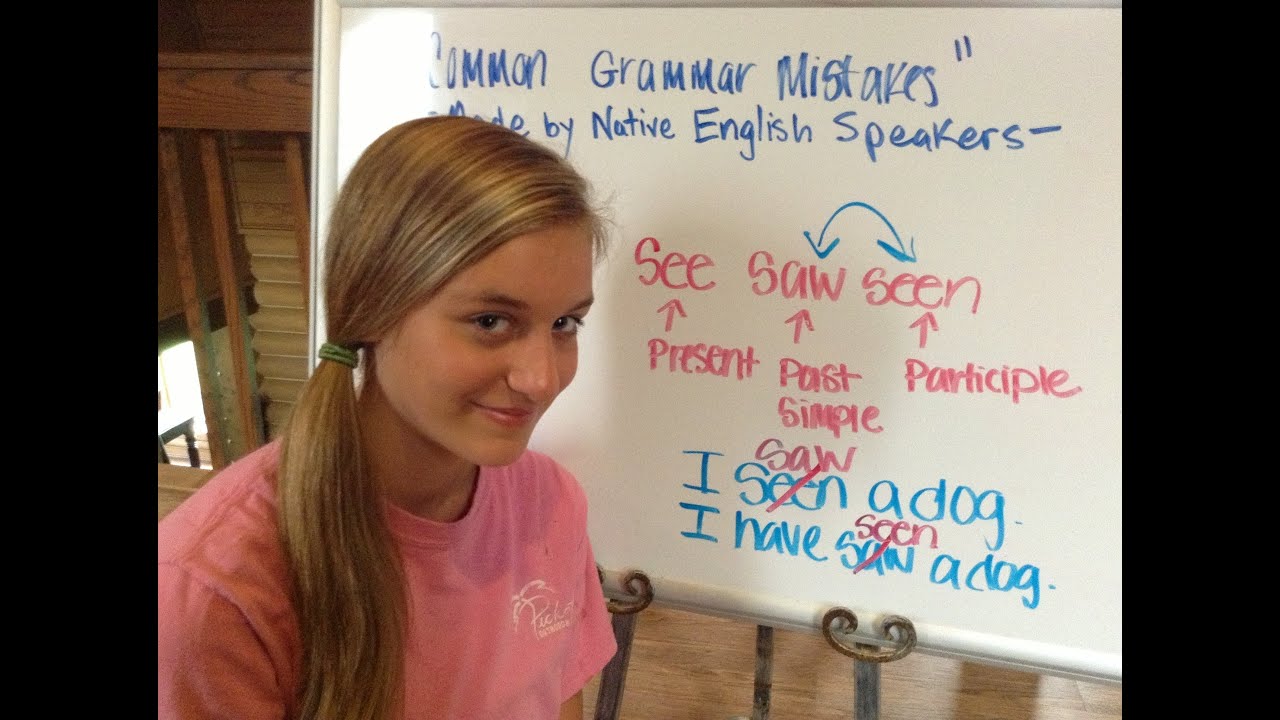
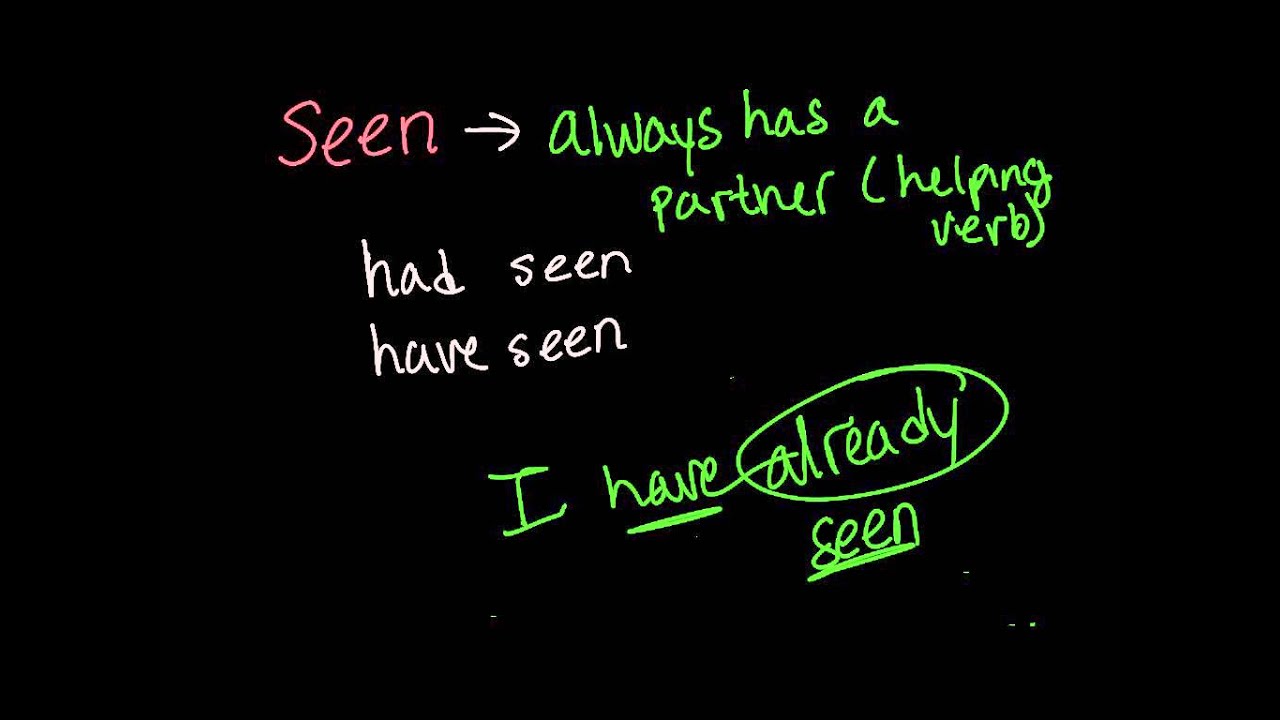
Seen and Saw - World-Leading Language Solutions by WhiteSmoke Saw is the past tense form of "see." Saw can be used by itself, without a helping verb. You saw me. I saw that movie. Seen is the past participle form of "see." Seen requires a helper verb, such as "have." I have seen that movie. A coyote was see n in the park yesterday. It is never correct to use "seen" without a helper verb. › adverbs-time-exerciseAdverbs of time exercise - Home of English Grammar Jan 31, 2012 · 1. I saw him yesterday. 2. I am seeing your father tomorrow. 3. My plane leaves tomorrow. 4. I haven’t seen her since Monday. 5. I went there yesterday. 6. I saw him yesterday morning. 7. I haven’t seen her today. 8. I haven’t seen her since yesterday. 9. I will do it first thing tomorrow. 10. I am seeing him tomorrow morning. 11. I might ...
see saw seen grammar Learn English ESL Irregular Verbs Grammar Rap Song: Grammar Rap Song слова песни. 17 Pics about Learn English ESL Irregular Verbs Grammar Rap Song: Grammar Rap Song слова песни : Saw vs. Seen | Helping verb, How to write a speech, English speaking skills, Past Tense Of Saw - -+9000 Pendant Lighting Modern and also "Disputation, Confrontation, and Dialectical Hullabaloo ...

Seen vs saw grammar
See How to Use 'Saw' and 'Seen' - Primary Worksheets - Twinkl Never have a helping verb in front of ' Saw ' - "I saw it." ' Seen ' is the opposite and requires a helping verb with it - "I have seen it." Twinkl Malaysia KSSR Primary Level 2 English Grammar Verbs SEEN vs SAW: How to Use Saw vs Seen in English? - Confused Words Oxide is usually seen in our daily life. You act as if you're ashamed to be seen with me. When to Use Saw Saw is the past tense of the verb see. It is a stand-alone verb, it doesn't need a helping verb to prop it up. Saw Examples: I was absolutely staggered when I saw the bill. He saw a stranger standing at the doorstep. Seen vs Saw in Sentence Examples - EnglishBix The English word saw is the past tense form of the word see, and it is usually used to highlight an event / action that happened in the past. 5 examples of sentences using saw : I saw him doing the work. They saw someone entering the room. Mark saw his friends in the market. She saw him with another girl. I saw the train. When to use Seen
Seen vs saw grammar. writingexplained.org › seen-vs-saw-differenceSeen vs. Saw: What’s the Difference? - Writing Explained After reading this post, you should ever again wonder to yourself, "Should I use seen or saw?" When to Use Saw Saw is the past tense of the verb see. It forms the simple past, which is used to express an action that has started and finished at a specific time in the past. I saw Star Wars yesterday. We saw the parade this morning. Using Saw and Seen correctly | Proofreading.ie There is a tendency to say I seen it instead of I saw it. EXPLANATION OF WORDS: Saw is the PAST TENSE of the verb see, and usually comes immediately after NOUNS and PRONOUNS. Seen is the PAST PARTICIPLE of the VERB see. Generally, seen is used alongside have, has, had, was or were in a sentence to make COMPOUND VERBS. "Seen" vs. "Saw" - What's The Difference? | Thesaurus.com Seen and saw are forms of the irregular verb see. Saw is the past tense form, as in I saw him yesterday. Seen is the past participle form and is used to form the perfect verb tenses, as in She has seen every movie in the series (present perfect tense) and She had seen every movie in the series until this one (past perfect tense). › support-for-teachingDifferences in American and British English grammar - article Introduction. Speakers of American English generally use the present perfect tense (have/has + past participle) far less than speakers of British English.In spoken American English, it is very common to use the simple past tense as an alternative in situations where the present perfect would usually have been used in British English.
Had seen vs saw : r/grammar - reddit " i seen it" is just a matter of using the past-participle case as the past tense, and it's identical to "i saw it", but it's not accepted as 'proper grammar'. It's common where i live, and happens for 'did/done' too. "I done it". Edit: typos 4 [deleted] • 7 yr. ago Past perfect simple. saw / seen | Common Errors in English Usage and More | Washington State ... saw / seen In standard English, it's "I've seen" not "I've saw." The helping verb "have" (abbreviated here to "'ve") requires "seen." In the simple past (no helping verb), the expression is "I saw," not "I seen." "I've seen a lot of ugly cars, but when I saw that old beat-up Rambler I couldn't believe my eyes." Back to list of errors › Tags › SatelliteSatellite News and latest stories | The Jerusalem Post Mar 08, 2022 · The Jerusalem Post Customer Service Center can be contacted with any questions or requests: Telephone: *2421 * Extension 4 Jerusalem Post or 03-7619056 Fax: 03-5613699 E-mail: [email protected ... Which One Is Correct: I Seen It or I Saw it? Seen vs Saw Examples With the help of some of the examples, you will get to know the core difference between the two words. I saw Batman yesterday. We saw cricket in the morning. We saw him jogging on the lawn. From the above examples, it has become clear that the word saw denotes the action which is already completed, and no other things are left to be done.
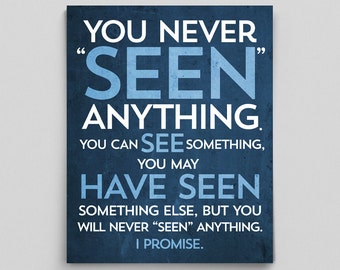
Seen Vs Saw | Grammar Quiz - Quizizz Q. What one is true? answer choices saw needs a past participle to make the statement true. (have, has, had, was, were) seen needs a past participle to make the statement true. (have, has, had, was, were) Question 5 30 seconds Q. What one is correct answer choices I seen the little kid on his bike I have seen the little kid on his bike Report Quiz GMAT Verbal Tips : 'Saw' vs 'Seen' - QS-LEAP For instance, "Steve saw the movie." 'Seen' is never used as a standalone verb and is generally accompanied by words such as 'have', 'had', 'was', among others. If anything has happened in the past, you have to use the word 'saw'. You cannot say "Steve has seen the race yesterday." Seen Vs Saw Grammar | Etsy Check out our seen vs saw grammar selection for the very best in unique or custom, handmade pieces from our digital prints shops. Seen vs. Saw : Which Word Should You Use? - The Blue Book of Grammar ... The Meaning of Saw and Seen As mentioned, both saw and seen refer to sight in the past tense. Specifically, saw is the past-tense version of the verb see. Seen is the past participle. That means it needs a helping verb to make it work. That subtle distinction is key to understanding seen vs. saw. If it seems unclear, don't worry.
I Ain't Seen It | MANITOWIKI
Seen Vs Saw Grammar | Etsy Check out our seen vs saw grammar selection for the very best in unique or custom, handmade pieces from our shops.

Why do artists create art? And what circumstances influence ...
en.wikipedia.org › wiki › Grammatical_aspectGrammatical aspect - Wikipedia ὁράω – I see (present); εἶδον – I saw (aorist); οἶδα – I am in a state of having seen = I know (perfect). In many Sino-Tibetan languages, such as Mandarin, verbs lack grammatical markers of tense, but are rich in aspect (Heine, Kuteva 2010 [full citation needed], p. 10). Markers of aspect are attached to verbs to indicate ...

Seen vs Saw - English Speaking Practice - YouTube
Is it more grammatically correct to say "I seen" or "I saw"? - Quora "I saw" is not just grammatically MORE correct but also the only correct answer here. Being the past participle/3rd form of the verb 'see', "seen" is always preceded by an auxillary verb in the active voice…here, "have"/"had"…which means, "I have seen.." or "I had seen.." are grammatically correct. Sponsored by Grammarly

I’m down with the clown and I’m down for life yo
› difference-betweenDifference Between Past and Past Participle | Compare the ... Jul 20, 2011 · “It could have been days, maybe weeks since she had seen him.” This is also correct, and contrasts the last time she saw him with another subsequent event in the past (By the time his letter came in the mail, it had already been days or weeks since she had last seen him.) I know this is three years old, but hope it’s helpful to someone. 😉

Saw vs. Seen | Helping verbs, English speaking skills ...
saw vs seen | Common Errors in English | saw or seen - BeeDictionary v take charge of or deal with. v receive as a specified guest. v date regularly; have a steady relationship with. v see and understand, have a good eye. v deliberate or decide. v observe as if with an eye. The camera saw the burglary and recorded it. v observe, check out, and look over carefully or inspect.

Seen vs. Saw: What's the Difference? - Writing Explained
see and saw grammar SEEN Vs SAW: How To Use Saw Vs Seen In English? - Confused Words confusedwords.org. ... See, Saw, Have Seen | Grammar Humor, Grammar Nerd, Grammar . grammar seen saw humor nerd importance proper using teaching ve writing. Tales From Miss D: Using Seesaw For Distance Learning

Seen Vs. Saw — What's the Difference? | by Taylor D. Levesque ...
en.wikipedia.org › wiki › Empty_stringEmpty string - Wikipedia Formal theory. Formally, a string is a finite, ordered sequence of characters such as letters, digits or spaces. The empty string is the special case where the sequence has length zero, so there are no symbols in the string.
Seen" vs. "Saw" – What's The Difference? | Thesaurus.com
Difference Between Saw and Seen • Saw is the simple past tense of see whereas seen is the past participle of see • Saw is used for an event or happening that took place in the past and is now over, whereas seen is used for an event that too took place in the past but not at any definite time. • Seen is used along with an auxiliary verb such as has, have, or had.
Which One Is Correct: I Seen It or I Saw it? Seen vs Saw Examples
Seen vs. Saw: Which Is Correct? (Helpful Examples) - Grammarhow Seen or Saw: Which Is Correct? "Saw" is correct when using the simple past tense. We do this to talk about "seeing" something in the past and having nothing more to "see" in the present. "Seen" is the past participle of "see," which requires an auxiliary verb before it makes any sense in a sentence. Both verb forms come with different rules.
Obiter . most useful to him.Thus Grammardom saw happier days ...
Seen vs Saw : r/grammar - reddit.com Agree. "They were never seen again" as opposed to "They were never saw again." 4. level 1. poilsoup2. · 2 yr. ago. Theres the implied part of the sentence " (they were) never seen again." So there still is a helping verb its just not explicitly stated here. Depending in the context, it still could be wrong though.
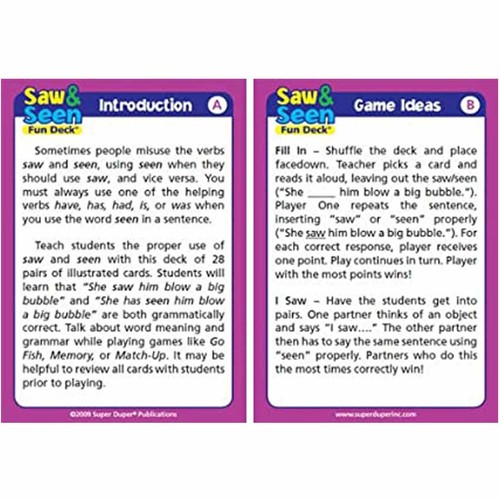
Saw & Seen Fun Deck Cards - Verbs - Super Duper FD143 New Speech Therapist
Has vs. Have: Proper Grammar Rules - YourDictionary To have and to hold, or to has and to hold? Find out which form to use in tricky situations such as present perfect tense and possession.
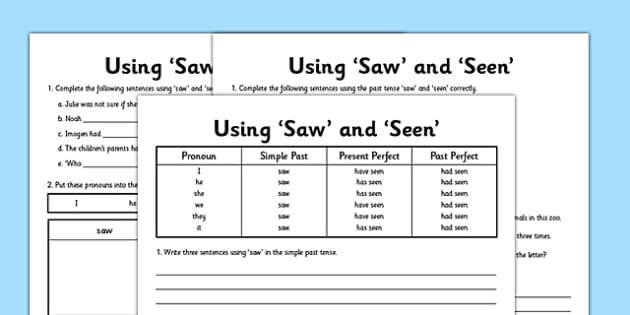
See How to Use 'Saw' and 'Seen' - Primary Worksheets
Saw or Seen? An Error's Still an Error, Even if It's Common! The past tense is saw. Sherry saw the woman shortly before she vanished. The detective saw potential evidence at the scene. Then we come to the past participle form. That's the form of a verb we use when we add a helping verb. The past participle form of see is seen. The woman was seen driving off.
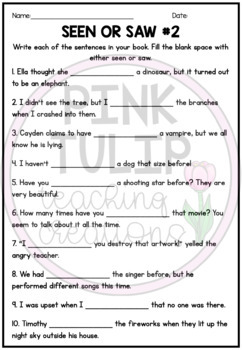
Seen or Saw Grammar Worksheets
tense - Difference between seen vs saw - English Language Learners ... The one seen at the beginning. The past participle is SEEN, not saw. But here, it's a passive tense: the one seen at the beginning [of the x by y]. Passives take the past participle. The agent of the passive verb: /seen at the beginning/ is implied. Saw can only be used with a pronoun or noun: We saw the boat in the harbor. -

Grade 1 Grammar: Saw and Seen printable worksheets – Lets ...
Seen vs Saw in Sentence Examples - EnglishBix The English word saw is the past tense form of the word see, and it is usually used to highlight an event / action that happened in the past. 5 examples of sentences using saw : I saw him doing the work. They saw someone entering the room. Mark saw his friends in the market. She saw him with another girl. I saw the train. When to use Seen

Grammar Set
SEEN vs SAW: How to Use Saw vs Seen in English? - Confused Words Oxide is usually seen in our daily life. You act as if you're ashamed to be seen with me. When to Use Saw Saw is the past tense of the verb see. It is a stand-alone verb, it doesn't need a helping verb to prop it up. Saw Examples: I was absolutely staggered when I saw the bill. He saw a stranger standing at the doorstep.

Seen Vs. Saw — What's the Difference? | by Taylor D. Levesque ...
See How to Use 'Saw' and 'Seen' - Primary Worksheets - Twinkl Never have a helping verb in front of ' Saw ' - "I saw it." ' Seen ' is the opposite and requires a helping verb with it - "I have seen it." Twinkl Malaysia KSSR Primary Level 2 English Grammar Verbs

Using Saw and Seen correctly | Proofreading.ie
Is it more grammatically correct to say 'I seen' or 'I saw ...
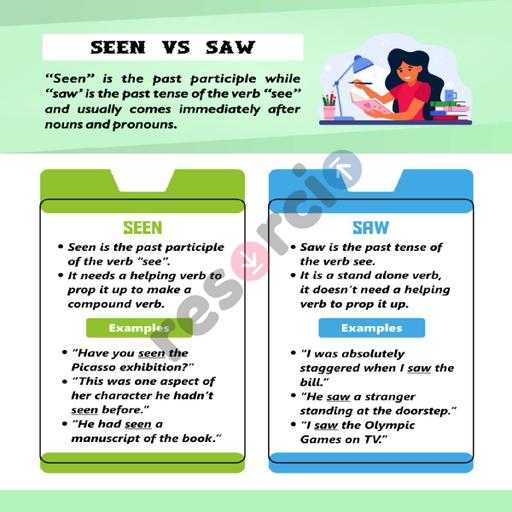
Grammar & Literary Concepts
Is it more grammatically correct to say 'I seen' or 'I saw ...

Seen vs. Saw: What's the Difference? - Writing Explained

Entire lesson: @iamthatenglishteacher ...

Seen Saw Funny Grammar Shirt Humor Men's Shirt Gifts for - Etsy
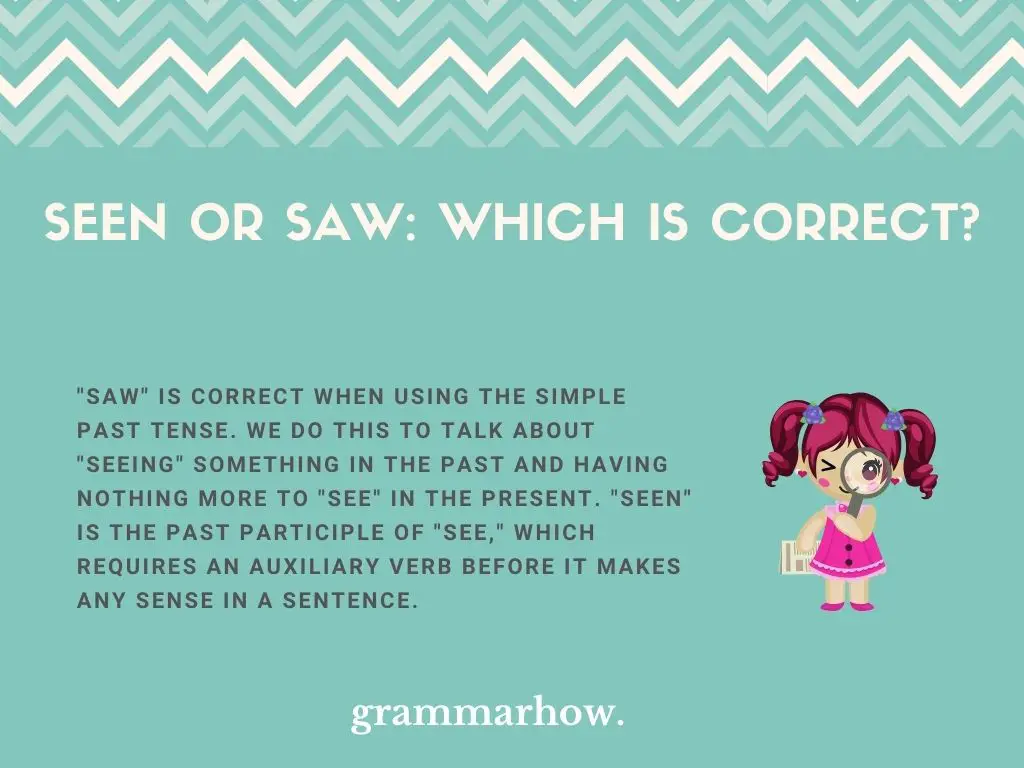
Seen vs. Saw: Which Is Correct? (Helpful Examples)

Seen or Saw Grammar Worksheets
See Saw Seen - Irregular English Verbs

Recipe: Spinach Chicken

See V1 V2 V3 V4 V5 Base Form, Past Simple, Past Participle ...
Seen vs See Grammar English Teacher Poster Grammar Gift for Teachers Typographic Print Editor Writer English Gifts Gag Gift Office Decor
Is it more grammatically correct to say 'I seen' or 'I saw ...

Grammar: see and saw aligned with Wonders Gr1 U4W4 Google slides and Seesaw link

Editor's Corner: Function and Functionality | Editor's Corner

Using Saw and Seen correctly | Proofreading.ie

Page:An elementary grammar of the Japanese language.djvu/30 ...

Seen" vs. "Saw" – What's The Difference? | Thesaurus.com

Grammar Lesson - See, Saw or Seen - YouTube
Saw or seen
English with Torrie: 5 Verb Mistakes

Grammar Unit: Double Negatives, Subject/Verb Agreement, & Seen vs. Saw

Present Perfect vs. Past Simple worksheet
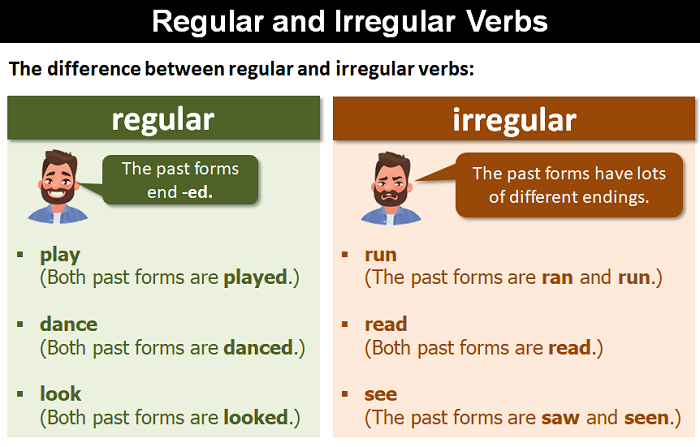
Irregular Verbs: Explanation and Examples

Seen vs saw | BabyCenter
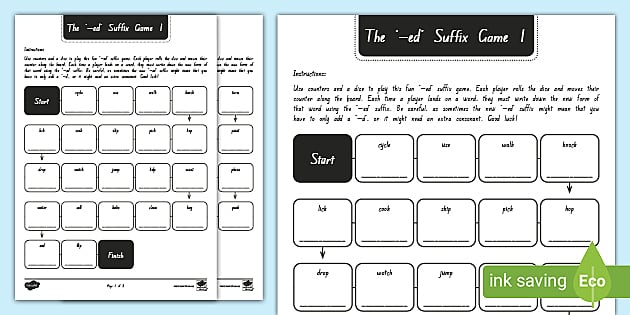
See How to Use 'Saw' and 'Seen' - Primary Worksheets

Using Saw and Seen correctly | Proofreading.ie
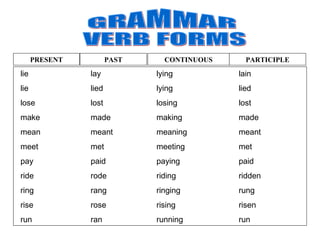
Simple Past Tense Rules for Primary
0 Response to "45 seen vs saw grammar"
Post a Comment