42 what do renewable and nonrenewable have in common
Renewable and Nonrenewable Resources - Penn State Extension The first are renewable natural resources. They are called renewable because they can grow again or never run out. The second are called nonrenewable natural resources. These are things that can run out or be used up. They usually come from the ground. Renewable natural resources Let's look more closely at renewable natural resources. What do renewable resources and nonrenewable resources have in common? Resources are characterized as renewable or nonrenewable; a renewable resource can replenish itself at the rate it is used, while a nonrenewable resource has a limited supply. Renewable resources include timber, wind, and solar while nonrenewable resources include coal and natural gas. Abhinav Shah
What are Renewable and Non-Renewable Energy Sources? | DeltaNet | DeltaNet Non-renewable energy sources Fossil fuels: Fossil fuels are non-renewable. This means that they will run out eventually, which is why the cost of energy is increasing. Coal, oil and natural gas are examples of fossil fuels. They're burnt to generate electricity - however, carbon dioxide is released during this process.
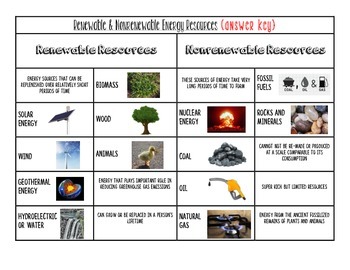
What do renewable and nonrenewable have in common
Facts About Renewable and Non-Renewable Resources - Greentumble Renewability is an important concept but not a pre-determined one. In other words, renewability of resources depends on whether or not these resources can be replenished within time frames that are meaningful to humans [3]. Why are fossil fuels non-renewable… Take the example of fossil fuels: coal, natural gas and oil were made through natural processes over millions of years. Renewable vs. Nonrenewable Energy Resources - CK-12 Foundation Renewable vs. Nonrenewable Energy Resources Compares and contrasts renewable and nonrenewable energy resources, which is based on whether a resource can be replaced faster than it is used or not. Progress What Do Renewable And Nonrenewable Resources Have In Common - Realonomics The difference between these two types of resources is that renewable resources can naturally replenish themselves while nonrenewable resources cannot. This means that nonrenewable resources are limited in supply and cannot be used sustainably. How are renewable and nonrenewable resources alike How are they different quizlet?
What do renewable and nonrenewable have in common. Compare and contast Renewable and Non-renewable by JamieF Smoth - Prezi Renewable and non-renewable resources have many similarities. They both are resources and they both have to do with the environment. Also, we must use them wisely because if not they will disipear.They both grow on Earth, as well. They are both from nature and people depend on them. Lastly, they both produce energy. A non-renewable Resource Renewable vs Nonrenewable Resources - Clean Energy Ideas Renewable energy sources include solar, wind, geothermal, hydro, and biomass. Together, they offer many benefits over nonrenewable alternatives such as coal, oil, and gas. We will now take a look at each of the main benefits. 1. Renewables Are Better For The Environment. Renewables are much better for the environment than nonrenewable alternatives. What do renewable resources and nonrenewable resources have in common ... The thing that renewable and non-renewable resources have in common is that they can both be used to produce electricity. Why is it important you use renewable resources not nonrenewable resources?... what do renewable and nonrenewable have in common Nonrenewable energy sources, like coal, oil, and natural gas, cannot be easily replenished.A renewable energy source can be more easily replenished.Common examples of renewable energy include wind, sunlight, moving water, and Earth's heat. To better understand renewable vs. nonrenewable energy…. Click to visit
What Do Renewable And Nonrenewable Have In Common Both renewable and non-renewable can be used to produce electricity. While renewable resources can be used and replenished in short periods non-renewable resources cannot be in the amount of time the are used. Coal and oil are non-renewable. Sunlight and wind are renewable resources. Examples of Renewable and Non-Renewable Resources - Greentumble This metal can be also found in the composition of the sun and stars, so we can say that it is a common element in the universe. We even have it in our blood (literally). But from the perspective of a resource, iron belongs to the category of non-renewable resources because it does not get naturally replenished. What do renewable and nonrenewable have in common How are they different? A nonrenewable resource is not replenished by natural means within a useful time frame. In this way, what do fossil fuels and renewable energy have in common? Fossil fuels, also known as non-renewable sources of energy, include fuels like coal, petroleum, natural gas, etc. Another common feature of both the fossil fuels and renewable sources is ... Difference Between Renewable and Nonrenewable Energy What do renewable and nonrenewable resources have in common? They are very different forms of energy. However, some of the things they have in common are: They cost money to generate and produce They produce jobs Biomass is also burned, like fossil fuels They can power our world How fast are renewables growing?
Define the terms renewable resource and nonrenewable and give examples ... There are many types of resources that go into producing food and producing forages. In general these resources have been grouped into two types: renewable resources and nonrenewable resources. Renewable resources may be defined as resources that have the potential to be replaced over time by natural processes. What do renewable and non-renewable resources have in common ... - Answers The thing that renewable and non-renewable resources have in common is that they can both be used to produce electricity. Science Energy Review Flashcards - Quizlet B Both are nonrenewable. C Wave energy is nonrenewable. Tidal energy is renewable. D Wave energy is renewable. Tidal energy is nonrenewable. a. Just under half the oil that enters ocean water comes from natural oil seeps on the ocean floor. Just over half the oil in the oceans comes from human activities. What Do Renewable And Nonrenewable Resources Have In Common What Do Renewable And Nonrenewable Resources Have In Common? They both are resources and they both have to do with the environment. Also we must use them wisely because if not they will disipear. They both grow on Earth as well. They are both from nature and people depend on them.
Renewable and Nonrenewable Energy Resources Sort by The Wright Ladies
What Is The Difference Between Renewable And Non-Renewable Resources On the one hand, renewable resources use natural resources to produce usable energy and electricity. But, on the other hand, it does not take thousands or millions of years to produce but instead is constantly produced because of the nature of our world. On the other hand, nonrenewable resources rely on fossil fuels.
PPT - Environmental Economics PowerPoint Presentation, free download ...
Characteristics of Renewable and Nonrenewable Resources Some characteristics of renewable resources are as follows: (i) These resources are capable of regeneration. (ii) These are renewed along with exploitation and hence, always available for use. (iii) The regeneration of these sources involves some ecological processes on a time scale. (iv) The renewable sources become nonrenewable if used at a ...

difference between renewable and nonrenewable source of energy Min 10 ...
How are nonrenewable and renewable resources alike? What do renewable and non-renewable resources have in common? ... Both renewable and non-renewable can be used to produce electricity. While renewable resources can be used and replenished in short periods, non-renewable resources cannot be in the amount of time the are used. Coal and oil are non-renewable.

khochirou aime iuka: Brazil From Wikipedia, the free encyclopedia Jump ...
What Could Cause A Renewable Resource To Become Nonrenewable What do renewable and nonrenewable resources have in common? How might a renewable resource become nonrenewable quizlet? How might a renewable energy source become nonrenewable quizlet?

What Is The Difference Between Renewable And Nonrenewable Energy ...
What is renewable and non-renewable energy? | updated August 2022 Renewable energies are those obtained from natural sources that produce energy inexhaustibly and indefinitely. For example, solar energy, wind energy or tidal energy are renewable sources of energy. They are also considered renewable when they are obtained from sources that regenerate naturally over time, such as forests.

khochirou aime iuka: Brazil From Wikipedia, the free encyclopedia Jump ...
What Do Renewable And Nonrenewable Resources Have In Common - Realonomics The difference between these two types of resources is that renewable resources can naturally replenish themselves while nonrenewable resources cannot. This means that nonrenewable resources are limited in supply and cannot be used sustainably. How are renewable and nonrenewable resources alike How are they different quizlet?
0 Response to "42 what do renewable and nonrenewable have in common"
Post a Comment